Getting it Fired Up
So the million dollar questions : Does it do anything? Does it let out magic smoke? Does it make noises? Ok ok, let’s see what happens…
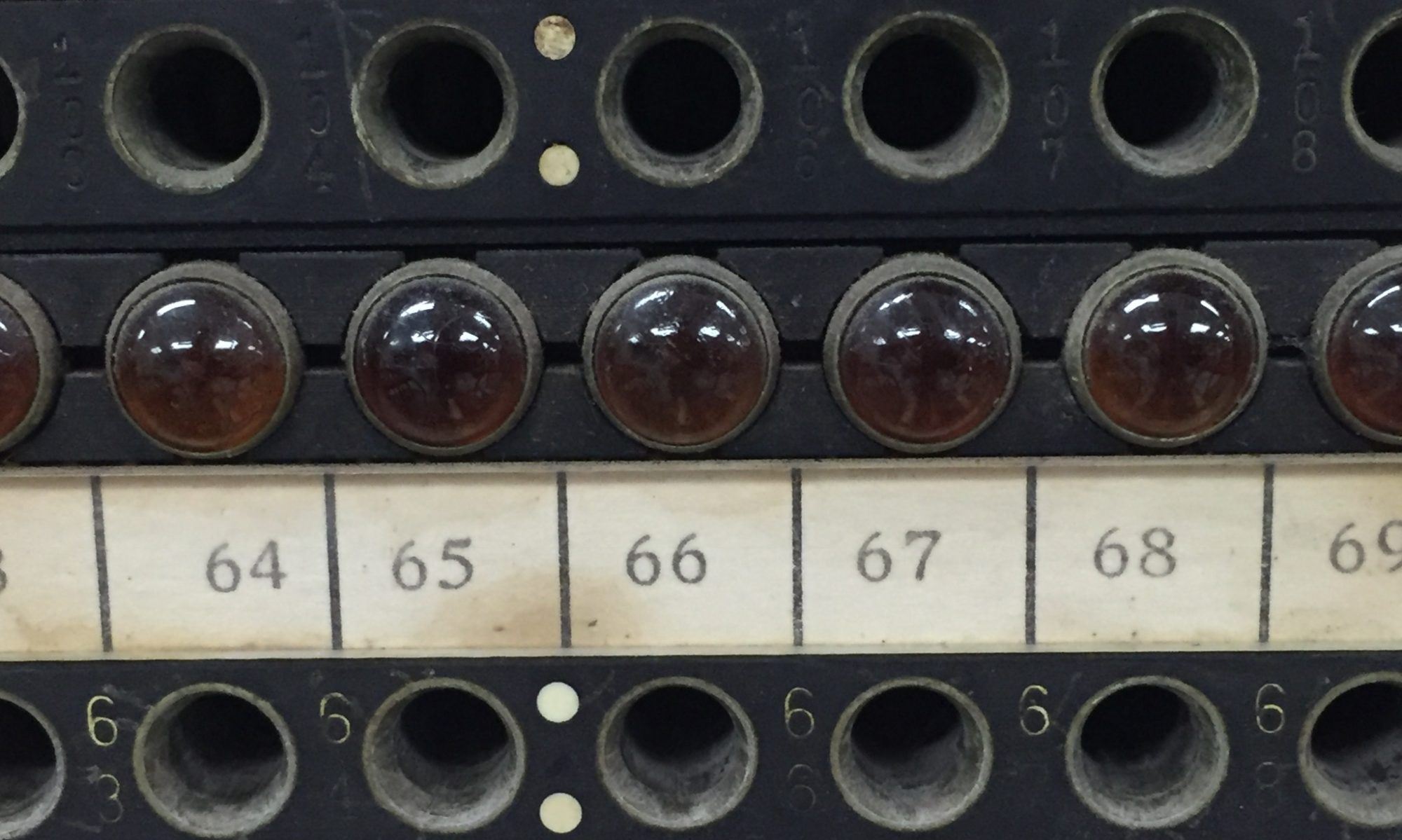
So it does power up, and LEDs on the front seem to be active as expected. Thats a good sign! Also as expected, the 8th T1 section is dark, as there’s a set of line cards missing for that slot.
After using an unholy mishmash of adapters and a null modem adapter, I was able to connect to it using a serial terminal running at 19200 baud, which I later confirmed was the right baud rate. I did get a prompt that appeared to be for commands, but trying things like a question mark, help, or menu produced no results. Thankfully I got a copy of the manual which listed the command set, and I had some luck trying a few of them. Particularly, using the ‘N’ commands that relate to networking, I was able to get the network jack, which turns out to be ethernet, to work and allow for a telnet session vs serial. It doesn’t seem to support DHCP, so only a fixed IP address.
Continuing on, it seemed that there was supposed to be a file system/flash type of storage, but the HD command (kinda like “dir”) reported an error. Upon rebooting the unit, there are bootloader lines that mentioned a ramdisk error. I later found this was likely someone wiping the flash storage, and using the MD command re-formatted the flash drive and filled it in with a small set of default files. Great! This fixed the ramdisk error seen at boot, and in addition, it now looks like the help commands work and explain them at the prompt. Looks good! Well…not so fast…
Hurdles
So things were looking good; the unit appears to work, both CPUs (connecting to each serial port) seemed to respond and things were looking up, until reading the manual more and doing some of the ‘R’ commands to get reports and specs, it listed no protocols available. Well thats not good! Later I learned that the protocols (IE line types, like FSX, FXO, E&M, etc) were actually files that needed to be installed, and came with the factory disks, which…I dont have. RATS. It seems this is a hurdle as the scripts used to generate the calls, basically defer actions like dialing, etc to the protocols, so without the protocol files, this is a large 23″ paper weight.
In addition, it seems that while it could really be ran and operated from the serial port, the software used to easily generate scripts and actions, called FeatureCall, was not easily found on the internet anywhere, and with Ameritec long out of business, that might make using this unit quite a bit harder (but not impossible).
Researching
So given this thing is a relic from the 90s, I went to my favorite archive, well, archive.org, and searched for old versions of the Ameritec website. While I was very successful in finding old pages and links, the “original disk” zips that it provided were not archived, and in fact, very little useful data other than manuals, brochures, and addendums were found. Doing similar Google searches got nowhere as well.
In Conclusion (for now)
So not everything is lost yet; I could potentially try to find the protocol files, although I do suspect that the line cards have SS7 roms on them. If that’s the case, I cannot use this to play with standard T1 stuff like off the shelf channel banks. Also, without the protocol files, its as a good as dead, or perhaps a parts donor. Those are some major hurdles though, and given an Asterisk box that could be much smaller, with a T1 card inside, could likely do everything this does, I’m not sure how much more effort I’ll bother putting into this. Its certainly fun to try to frankenstein these devices back into operation, but with little hope for finding the missing bits, it might not be worth it on this one. (Other units that have the proper cards and/or protocol files may be a different story).
There’s other versions of this device, including analog ones that have RJ11 line jacks that may be much more useful than this iteration. I still think this would be a fun device to play with if working. If you have one of these laying around and are willing to try to archive the files inside, or have original disks or software, or perhaps archive rom images, please reach out!
So let’s sum up what we’ve found about this unit:
- It’s HUGE. 4U and 23″ wide
- This unit might have swapped boards that do System 7 signalling, and not CAS as hoped. As such, even if fully working, it might not be of any use to me or a typical telephony hobbyist
- It seems to work and respond via serial interfaces
- I had to restore the file storage area using the MD command, and reboot. There’s also a CI command that resets the default files as well.
- Restoring the file area resulted in a basic set of a few files, and cleared ramdisk errors on booth
- It also exposed the fact that no “protocols” were installed on the unit via the “RA” command, which are normally files that get imported. As such, the unit is dead in the water to its original purpose. Some quick searching found that these files aren’t easily found.
In conclusion, while I didn’t spend much on this, there’s certainly buyers regret that I couldn’t have any fun with it, other than learning about it a bit and getting to do some research. As big as it is, time will tell if I bother to store it for long; I may just pass it along at a hamfest, or scrap it for parts and move on. We’ll see!